



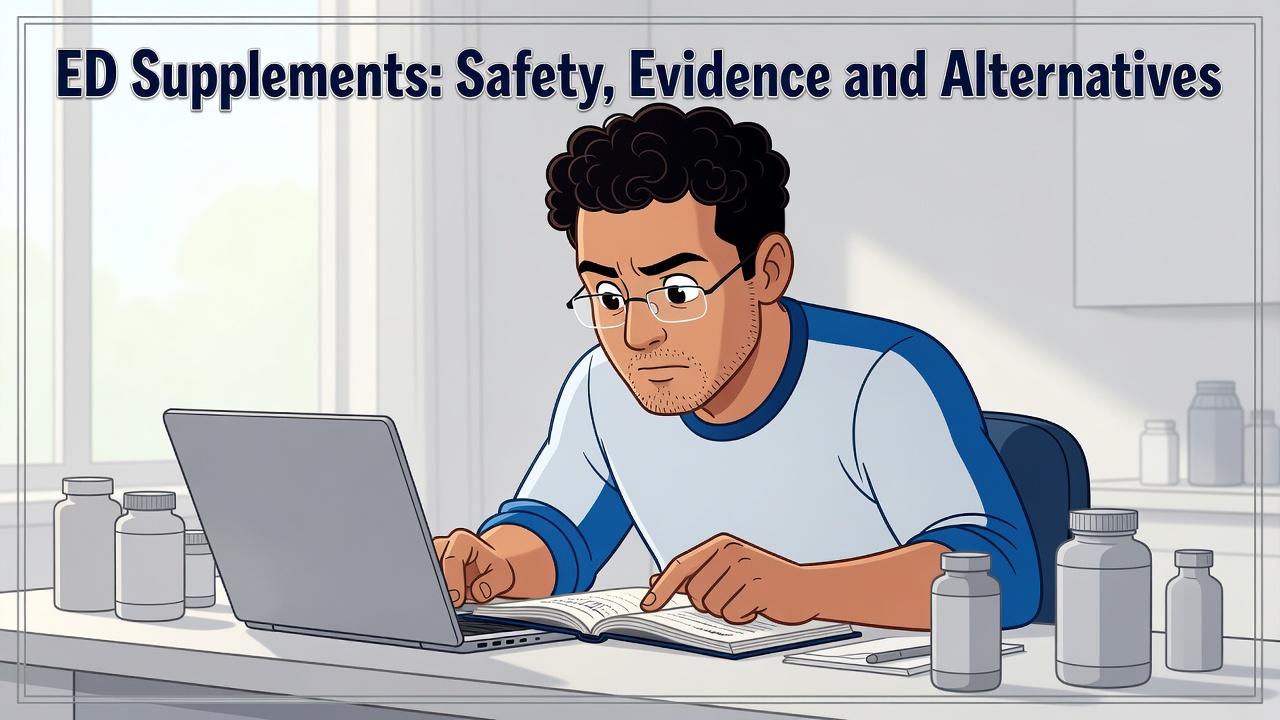
ED Supplements: Safety, Evidence and Alternatives
Short Version
- No herbal or over-the-counter ED supplement has received FDA approval to treat erectile dysfunction.
- Some ED supplements may contain undisclosed pharmaceutical ingredients that can interact dangerously with heart medications.
- Erectile dysfunction can be an early signal of cardiovascular disease, making a medical evaluation worthwhile before self-treating.
- Prescription PDE5 inhibitors have far stronger clinical evidence behind them than any supplement currently on the market.
ED supplements are unregulated products sold without a prescription for erectile dysfunction, but no over-the-counter herbal supplement is recommended as a first-line treatment by any major medical body. The gap between marketing claims and clinical evidence is significant, and some products carry documented safety risks.
Erectile dysfunction is common, and the desire for a discreet, easy solution makes sense. But NHS guidance on erection problems makes clear that effective treatments exist and that a GP can help identify underlying causes that self-treatment with supplements may leave unaddressed.
What Are ED Supplements and How Are They Marketed?
ED supplements are products sold without a prescription and classified as dietary supplements rather than medicines, which means manufacturers are not required to prove they work or that they are safe before sale. Common ingredients include Panax ginseng, L-arginine, horny goat weed (epimedium), maca root, yohimbe, and zinc, among many others.
Marketing for these products tends to imply rapid results, complete safety, and all-natural origins. Claims like “clinically tested,” “doctor-approved,” or “as seen on TV” appear regularly, even when no peer-reviewed clinical trial supports the specific product being sold. The American Urological Association’s ED clinical guideline does not recommend any over-the-counter herbal supplement as a first-line treatment for erectile dysfunction, a distinction that advertising rarely mentions.
Suggestions
- Move most days – even a brisk 30-minute walk supports blood flow.
- Eat more whole foods, nuts and leafy greens; go easy on alcohol.
- Protect sleep and manage stress – both affect performance.
What Clinical Evidence Shows About ED Supplements
No herbal or over-the-counter ED supplement has received FDA approval to treat erectile dysfunction. A peer-reviewed PMC review on ED diagnosis and management (PMC4394737) notes that the literature includes small trials examining high-dose L-arginine for blood flow support and Panax ginseng for ED, but describes the overall evidence across supplement ingredients as mixed at best.
That same PMC review (PMC4394737) notes that the evidence base for herbal supplements is limited by small sample sizes, inconsistent methodology, and short follow-up periods. That makes it difficult to draw firm conclusions about their usefulness. Many trials also test isolated ingredients at doses higher than those typically found in commercial blends, so even cautiously positive findings may not translate to the product on a shop shelf. And for many men, the promise of a herbal solution may mean delayed care for underlying health problems.
ED Supplement Safety Risks: Contamination, Drug Interactions, and FDA Warnings
ED supplements may pose genuine safety risks beyond the question of effectiveness. Independent laboratory testing by regulatory bodies, including the FDA, has repeatedly found that products marketed as “all-natural” sexual enhancement supplements contained undisclosed pharmaceutical ingredients, including sildenafil analogues and other PDE5 inhibitor compounds not declared on the label.
This is not a minor labelling technicality. Men who take nitrate medications for heart conditions can experience a potentially life-threatening drop in blood pressure if they also consume sildenafil or a similar compound, even unknowingly. The interaction between nitrates and PDE5 inhibitors is well-documented and serious. Mayo Clinic’s ED treatment guidance specifically flags this interaction as a reason why any treatment for erectile dysfunction should be discussed with a healthcare provider before use, particularly for men with cardiovascular conditions.
Yohimbe, an ingredient found in many ED supplements, can raise blood pressure and heart rate and may interact with antidepressants. High doses of zinc over extended periods can interfere with copper absorption. These are not theoretical risks. They are reasons why the casual purchase of an ED supplement carries more uncertainty than the packaging typically acknowledges.
Proven Medical Treatments for Erectile Dysfunction
Oral PDE5 inhibitors, including sildenafil, tadalafil, vardenafil, and avanafil, are the recommended first-line pharmacological treatment for most men with ED, according to the American Urological Association. These treatments have been studied in large, randomised controlled trials and are approved by regulatory agencies for the treatment of erectile dysfunction. The AUA guideline lists oral PDE5 inhibitors as first-line therapy, noting consistent evidence of efficacy across a broad population.
Beyond medication, lifestyle changes can play a meaningful role. The NHS notes that for many men, addressing contributing factors such as alcohol intake, smoking, physical inactivity, stress, and relationship difficulties may help improve erections. Psychological therapies, including cognitive behavioural therapy, can also benefit men whose ED has a significant psychological component. Vacuum erection devices and, in carefully selected cases, surgical implants are additional options a urologist can discuss.
The key difference between these approaches and most ED supplements is not simply that they require a prescription. It is that they’ve been subjected to rigorous testing, their benefits and risks are documented, their interactions are understood, and a clinician can tailor them to an individual health profile.
Erectile Dysfunction as a Potential Cardiovascular Warning Sign
Erectile dysfunction can be an early marker of cardiovascular disease, because the arteries supplying the penis are smaller than coronary arteries and may show vascular changes before a cardiac event occurs. Mayo Clinic’s overview of ED symptoms and causes notes that this vascular relationship may make ED an early warning sign worth investigating.
The PMC review on ED diagnosis and management highlights the cardiovascular link, noting that men presenting with erectile dysfunction should be assessed for cardiovascular risk factors as a standard part of their evaluation. The CDC’s cardiovascular risk factor guidance identifies high blood pressure, high cholesterol, diabetes, obesity, and smoking as major contributors to heart disease, many of which are also independently associated with erectile dysfunction. A doctor assessing ED can screen for these conditions, potentially catching them at a stage where intervention may be most effective. Spending months self-treating with supplements may delay that evaluation at precisely the time when it could matter most.
Questions Anyone?
Do ED supplements actually work according to clinical research?
Not reliably. No over-the-counter ED supplement has received FDA approval, and the PMC review (PMC4394737) notes that most herbal supplement trials are too small and methodologically inconsistent to support firm conclusions. A useful check when evaluating any product’s evidence claims: did those studies test the exact product, at the stated dose, against a placebo, in a peer-reviewed journal? Most ED supplements cannot clear that bar. Licensed prescription treatments remain the only options that can.
Are ED supplements safe to take alongside prescription medications?
Not necessarily safe, and one practical step is easy to miss: take the supplement’s full ingredient list to a pharmacist before buying. Pharmacists can quickly flag compound names that are not obviously pharmaceutical-sounding but act as PDE5 inhibitors — exactly the hidden ingredients that can cause a dangerous blood pressure drop in men taking nitrate heart medications. This risk is highest with blended so-called natural products carrying no independent laboratory testing. A GP consultation provides broader safety context, but a pharmacist check on the specific product is a low-barrier first step.
Can erectile dysfunction be a warning sign of a more serious condition?
Yes. A standard GP assessment for ED typically covers blood pressure, a fasting glucose check for diabetes, a lipid panel, and sometimes a hormone test — fast, inexpensive tests that can identify conditions responding well to early treatment. ED can also be linked to diabetes, hormonal imbalances, neurological conditions, and mental health factors. No ED supplement addresses any of those root causes, which is why months of self-treatment may delay a diagnosis at exactly the point when intervention is most likely to help.
What treatments for ED have strong medical evidence behind them?
Oral PDE5 inhibitors, backed by large randomised controlled trials and recommended as first-line therapy by the AUA, have the strongest evidence base. Worth knowing: generic versions of sildenafil and tadalafil are widely available in many countries at a fraction of branded prices, and regulated online prescribing clinics in some regions offer discreet access after a brief medical review — making cost and convenience weaker arguments for choosing an unproven supplement. Lifestyle changes, psychological therapies, and in some cases more specialised interventions are additional options a GP or urologist can tailor to individual circumstances.
| Supplement Type | Evidence Level | Key Safety Concern |
|---|---|---|
| L-arginine | Moderate | Blood pressure changes; drug interactions |
| Korean red ginseng | Limited | Insomnia; GI upset possible |
| DHEA | Mixed | Possible hormonal side effects |
| Yohimbine | Modest | May raise blood pressure or anxiety |
| Zinc / magnesium blends | Weak (mainly for deficiency) | Generally well tolerated |
When to See a Doctor
Talk to your doctor before you start, stop, or change any treatment, and if symptoms are new, persistent, or getting worse. Seek emergency care right away if you have chest pain, fainting or severe dizziness, an erection lasting more than 4 hours (priapism), or any thoughts of suicide.

By Info Men’s Health Editorial Team
Reviewed against medical sources on 2026-11-07.
Info Men’s Health is an independent education site; our Editorial Team reviews every article against primary medical sources. This is not medical advice.
Sources
- NHS: causes, treatments and when to see a GP for erection problems
- Mayo Clinic: ED symptoms, causes and the link to heart disease
- Mayo Clinic: ED diagnosis and treatment options
- CDC: cardiovascular risk factors
- PMC review: current diagnosis and management of erectile dysfunction, including the cardiovascular link
- American Urological Association: ED clinical guideline
Medical disclaimer: This article is for informational purposes only and is not a substitute for professional medical advice, diagnosis, or treatment. Always consult a qualified clinician about your individual situation.